A look at the folkloric customs associated with
Halloween in Cornwall
by Alex Langstone
Traditional turnip lantern and Allan apples. Illustration by Paul Atlas-Saunders
Historic details of the traditional celebration of 31st October in Cornwall are scant, to say the least. But there does seem to be remnants of something tangible, that was marked as a calendar custom, at least during the nineteenth century. The Cornish language for the seasonal change at All Hallows was called Cala' Gwav, meaning the first day of winter and in Penzance and St Ives we have a couple of written accounts of how the festival of ‘Allantide’ or ‘Allan Day’ was celebrated.
In Lostwithiel and district we have clues that seem to knit together the recognition of All Hallows Eve with ‘Penny for the Guy’ and Bonfire night, and in Stratton, we have a fantastic account of a full-on festival of fireworks, hill-top bonfires, traditional music, outlandish costumes and fiery processions through the heart of the North Cornwall town.
In the traditional Cornish mining town of Camborne, we have an interesting seasonal tale of ‘Up in a Cold Ivy Tree’, which was traditionally told on All Souls Eve. The tale incorporates the divinatory ‘Hemp-seed charm’, which was associated with this particular time of year, and close to Newquay, we have folkloric associations with All Hallows and the holy well at Holywell Bay.
It was Margaret Ann Courtney, the nineteenth century Penzance folklorist who collected the Allantide information that is often repeated today. This early draft, from the 1886 Folklore Journal, describes the old traditions from Penzance and district. Much of this information would be later published in 1890, in her most well-known work, Cornish Feasts and Folklore.
On the nearest Saturday to Hallowe'en, October 31st, the fruiterers of Penzance display in their windows very large apples, known locally as Allan apples. These were formerly bought by the inhabitants and all the country people from the neighbourhood (for whom Penzance is the market-town), and one was given to each member of the family to be eaten for luck. The elder girls put theirs, before they ate them, under their pillows, to dream of their sweethearts. A few of the apples are still sold; but the custom, which, I have lately been told, was also observed at St. Ives, is practically dying out. On Allantide, at Newlyn West, two strips of wood are joined crosswise by a nail in the centre, at each of the four ends a lighted candle is stuck, with apples hung between. This is fastened to a beam, or the ceiling of the kitchen, and made to revolve rapidly. The players, who try to catch the apples in their mouths, often get instead a taste of the candle. In Cornwall, as in other parts of England, many charms were tried on Hallowe'en to discover with whom you were to spend your future life, or if you were to remain unmarried, such as pouring melted lead through the handle of the front door key. The fantastic shapes it assumed foretold your husband's profession or trade. Rolling three names, each written on a separate piece of paper, tightly in the centre of three balls of earth. These were afterwards put into a deep basin of water, and anxiously watched until one of them opened, as the name on the first slip which came to the surface would be that of the person you were to marry. Tying the front door key tightly with your left leg garter between the leaves of a Bible at one particular chapter in the Song of Solomon. It was then held on the forefinger, and when the sweetheart's name was mentioned it turned round. Slipping a wedding-ring on to a piece of cotton, held between the forefinger and thumb, saying, "If my husband’s name is to be let this ring swing! " Of course, when the name of the person preferred was spoken, the holder unconsciously made the ring oscillate.
Robert Hunt also recorded some ‘Allantide’ traditions in Popular Romances of the West of England, where he had the following to say:
The ancient custom of providing children with a large apple on Allhallows-eve is still observed, to a great extent, at St Ives. "Allan-day," as it is called, is the day of days to hundreds' of children, who would deem it a great misfortune were they to go to bed on "Allan-night" without the time-honoured Allan apple to hide beneath their pillows. A quantity of large apples are thus disposed of the sale of which is dignified by the term Allan Market.
A first-hand account from the historic Stannary town of Lostwithiel, records that up until the 1960s the children of the town would mark the seasonal change at All Hallows by carving turnip lanterns and making a ‘penny for the Guy’. The emphasis for the celebration was a combined focus, mixing All Hallows Eve turnip lamps and the lead up to Bonfire night with the emphasis on collecting money with the ‘penny for the Guy’.
A traditional All Hallows’ tale, once told in Camborne was called ‘Up in a Cold Ivy-Tree’ The tale deals with the theme of lost love, treachery and betrayal, and features the hemp seed charm, that is mentioned elsewhere within Cornish folklore. The divination charm, which was traditionally performed either in a churchyard or woodland, was cast to give foresight, to see if a girl’s sweetheart would follow her and be true.
“Hemp-seed I sow, hemp-seed I grow; let my young man come after me and mow.”
The tale goes something like this. A young lady was betrothed to be married to her sweetheart, but as the day grew nearer, his love had begun to cool. She wondered what was occurring, fearing another woman and as All Hallows was approaching, she decided to repeat the ‘Hemp-seed charm’ to ‘try his faith’. She decided to go and view her favoured spot, deep within the local woods, by day to check it was clear of any fallen branches or other such things that she might trip over when she returned on the night of All Hallows Eve. When she arrived at her favoured and secret spot, she was surprised to find a newly dug grave under the tree. She could not understand why this had been dug at this spot, so she decided to return a bit earlier than planned, to see if she could discover what was going on, before she cast her spell. Upon her return at dusk, she decided to climb up into the branches of the overhanging tree and wait to see what happened. For a few hours, all was quiet, but as the church clock struck midnight, she heard footfalls from the darkness. It was her young man carrying a hatchet under his arm. He waited by the grave, and it seemed he was waiting for someone else to arrive. However, no-one came, and after a while he left for home, somewhat agitated. At day-break, she decided that it was safe to descend from the tree and she ran home. A few days later her young man called for her, and this is what was said:
Boy: Where did you sleep last Saturday night? Girl: Up in a cold ivy-tree, two foal foxes under me, digging a grave to bury me. First I heard a cock crow, then I heard the wind blow, then I heard the chimb-chamb, chewing up his bridle, then I heard the water man, turn the engine idle.
There are other stories which feature the All Hallows Hemp seed incantation. The Spectre Bridegroom by Hunt and Nancy Trenoweth, the Fair Daughter of the Miller of Alsia, by Bottrell. These two tales, retold in their own inimitable style clearly show the spell being worked around Halloween. In other stories the same spell is performed at Midsummer, showing that above all, these two festivals were powerful times of divination and magic.
It was All-hallows Eve, and two of Nancy's companions persuaded her -no very difficult task-to go with them and sow hemp-seed. At midnight, the three maidens stole out unperceived into Kimyall town-place to perform their incantation. Nancy was the first to sow, the others being less bold than she. Boldly she advanced, saying, as she scattered the seed, "Hemp-seed I sow thee, Hemp seed grow thee; and he who wilt my true love be, come after me and shaw thee."
William Bottrell’s version of the tale is more descriptive -
So overpowering was the desire of Nancy Trenoweth to know the fate of her lover and if it were destined for her ever to become the bride of Lanyon, that, in company with two other love-sick damsels who were equally agitated by hopes and fears. she assayed what was then regarded as one of the most potent and fearful incantations, to induce the Powers of Darkness to lift the veil from that portion of their future destiny which they regarded as the main object of their existence; when Allhallows eve came, they had all three prepared for the spell of sowing hemp-seed. Near the midnight hour, with the moon shining bright, Nancy left the house quietly (for fear of disturbing the old couple, who had long retired to rest), and met her companions in the town-place, where they had agreed to meet and work their spells. Nancy and one of her companions drew their circles at a good distance from, but within sight of, each other. Nancy was the first to sow the magic grains, and pronounce the seemingly harmless incantation of — "Hemp-seed! I sow thee. Hemp-seed, grow thee, and he who will my true love be, come after me, and mow thee."
No sooner were the words three times spoken than a lurid thundercloud obscured the light of the moon. At the same instant a cloud of mist came sweeping in from over sea, rolled up the cleves with the speed of a whirlwind, came careering on to Kimyel town-place, and gathered around the circle in which Nancy stood, trembling with affright at the fearful visions her spells had summoned. The wind rose to a violent tempest, and the waves seemed to be breaking and surging around her. The dark clouds overhead became one sheet of flashing flames, which showed her The Apparition of Lanyon, surrounded by the surging waves and dripping wet, as if he had been drawn through the sea. He stood before her, dressed in outlandish garb—with a long and flowing coal-black beard, and glared on Nancy with such a look of terrible anger that she gave a fearful shriek, and the vision instantly disappeared.
The relationship between All Hallows and Bonfire Night is intriguing. As previously stated, in Lostwithiel during the mid-twentieth century, the two observances were inextricably linked. Therefore, it is interesting to note a few other traditions at this time of year, which were practised across Cornwall. The beginning of November sees the old observance of ringing night. Held on the 4th November, the church bells were rung from town and village across Cornwall to announce the foiled gunpowder plot and the commemoration of this, which would take place the following night. On the 5th in Padstow, Skip Skop Night was once celebrated by the local youths, who would project stones at doors and beg for money to buy fireworks. If no money was given a shower of limpets and dirt would be thrown. On the same night flaming tar barrels were once paraded through Fowey, until in 1862 the local authorities fined two men for lighting barrels in the town centre.
The most celebrated of the 5th November festivals was held at Stratton, and Margaret Courtney describes the event in all its glorious pageantry.
The Bude fife and drum band headed a grotesque procession, formed at Howl's Bridge, and second in order came a number of equestrian torch-bearers in all kinds of costumes, furnished by wardrobes of Her Majesty's navy, the Royal Marines, the Yeomanry, and numerous other sources. ' Guido Faux ' followed in his car, honoured by a postilion and a band of Christy Minstrels; then came foot torch-bearers, and a crowd of enthusiastic citizens, who ' hurraed ' to their hearts' content. Noticeable were the banners, ' Success to Young Stratton,' the Cornish arms, and ' God save the Queen.' The display of fireworks took place from a field overlooking the town, and the inhabitants grouped together at points of vantage to witness the display. The bonfire was lit on Stamford Hill, where the carnival ended. Good order and good humour prevailed.
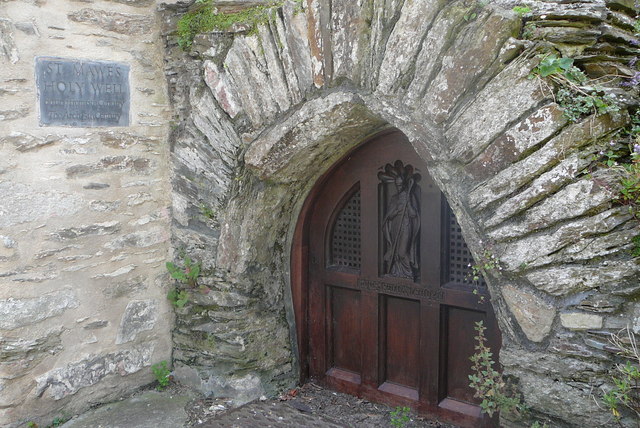
The famed holy well found inside a craggy tidal cave at Holywell Bay in the parish of St Cubert, was once visited and revered on All Hallows Day due to first having its virtues discovered on the feast of All Hallows. This is one of the most unique holy wells in Britain. Only reached at low tide, this remarkable well is truly bound by the elements. The qualities of this healing place have seen miraculous cures over the centuries.
This well has Nature only for its architect, no mark of man's hand being seen in its construction; a pink enamelled basin, filled by drippings from the stalactitic roof, forms a picture of which it is difficult to describe the loveliness.
© Alex Langstone
References:
The Folk-Lore Journal Volume 4 1886, p 111
Popular Romances of the West of England by Robert Hunt: ‘All Hallows Eve at St Ives’
Caroline Blick, personal correspondence 'Lostwithiel All Hallows and penny for the guy'
Old Cornwall Vol III No 5, Summer 1938: Up in a Cold Ivy-Tree by Bessie Wallace, p 205
The Folklore of Cornwall by Tony Deane and Tony Shaw, p 171
Cornish Feasts and Folklore by Margaret Courtney, pp 4 - 5
Ibid, p 3
Ancient and Holy Wells of Cornwall by Mabel and Lilian Quiller Couch, p 56
For more Cornish Folklore, check out my book, available from Troy Books. Click the image below to find out more.